
In celebration of Net Zero Week 2025, we spoke to Tom Pakenham, Commercial Director of Net Zero at Hive, to find out what the future of smart home heating looks like, and how innovation is powering the journey to a cleaner, more sustainable future. He’s somewhat of an expert having converted his 100+ year old home into a carbon-neutral Passivhaus.
Hi Tom, what’s your vision for the future of smart home heating, and Hive’s role in it?
My vision for the future of smart home heating is that all homes will eventually be heated using electricity. That could be through a heat pump or a zero-emission electric boiler.
We’re already seeing this transition in other areas, like the rise of electric vehicles. More and more people are driving EVs, and I believe the same shift should apply to heating.
What makes this transition particularly interesting is that it needs to be smart. We need smart, flexible electricity consumption. For example, you might avoid heating your home during peak hours, say between 4:00 and 7:00 in the afternoon, but preheat a little earlier to ensure it’s warm enough. Then, once the peak has passed, you can top up the heat. It’s about finding ways to make heating flexible and responsive.
So, smart, renewable, flexible electric heating is the future of home heating. Hive’s role in that future is to be the brain, the assistant that helps the householder manage it all. We want to make it simple and affordable.
Some people love geeking out over energy, heat, and kilowatt-hours, but most people just want their home to be warm, their bills to be manageable, and their system to be reliable.
"That’s Hive’s mission: to make smart home heating simple and affordable. And crucially, to make it accessible to everyone. This future can’t just be for a select few, it has to be for everyone. That’s why affordability is such a key part of our role."
Tom Pakenham, Commercial Director of Net Zero at Hive
What’s one piece of advice you’d give to someone starting their journey to a net zero home?
Definitely make sure you have a smart meter. You really can’t do much without one, especially when it comes to electricity and flexible energy use. It’s the foundation for everything else.
And on a more personal level, some spiritual advice: if you’re starting your journey to a net zero home, remember that you’re helping to build a better world. You’re actively participating in shaping a more sustainable future. Enjoy that feeling, because you’re playing a big part in something meaningful.
Hive is now over 10 years old, how important is it for helping households become more energy-efficient and sustainable?
We’ve now got nearly 2.5 million users and every week 8,000 new homes join the platform. Hive will always be known for the smart thermostat, but it is evolving into a comprehensive smart home energy management system. Building on the thermostat, we now offer heat pump controls, solar panels, battery storage, and EV charging solutions — all designed to use energy when it’s cleanest and cheapest.
What’s a good starting point for those considering a net zero journey at home?
I'd say take the Hive Challenge , a free and quick digital home energy health check that’s accessible to everyone online and offers personalised recommendations on how to save energy and money with just a few simple questions. So, if you haven’t done the Hive Challenge already, I’d highly recommend giving it a try.
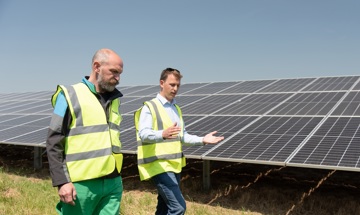
Solar panels are another exciting product. I don’t have them myself because my roof isn’t suitable, but many people get the biggest kick out of using solar panels and energy storage. You can literally see the meter ticking over and the electrons flowing into your battery. Well, not literally, but you can see it all happening in the app! You might think, “I’m powering my oven with energy I stored earlier today,” or “I’m running my computer on solar power.” It gives people a real sense of power.
But it’s vital we make technology like that accessible. A solar system might cost £8,000 to £9,000, which is far beyond what most people can afford from their savings. So, we’ve partnered with a company called SunSave to offer a fully financed, no-upfront-cost solar solution.

Hive Thermostat

Hive Heat Pump

Hive Solar

Hive EV Charging
"Building on the thermostat, we now offer heat pump controls, solar panels, battery storage, and EV charging solutions — all designed to use energy when it’s cleanest and cheapest."
Tom Pakenham, Commercial Director of Net Zero at Hive
What’s next in terms of smart home innovation and technology?
We work closely with the Centrica team Energised Futures, part of our New Business and Net Zero team. They’re doing cutting-edge work, closely connected with universities and academic institutions, looking at what’s coming next and identifying the most exciting innovations. Their insights feed directly into our commercial and product teams, helping us anticipate trends and shape future offerings.
On top of that, we’ve always had strong data science capabilities, but Centrica has recently made significant investments in building a centralised data function. We’re now working closely with that team on everything from practical improvements, like deeper insights into customer behaviour, market trends, and product development priorities.
We recognise that innovation often comes from outside our organisation, so we’ve shifted our mindset to embrace partnerships. We work with a wide range of manufacturers through our Works with Hive programme, and we’ve also built relationships with installers outside the Centrica family, people who are out there fitting solar panels and EV chargers. We learn a lot from them, even seemingly small details. These practical insights can make or break an installation.
How do we rocket boost the transition?
There are so many things going on, it’s crazy how much is happening right now. I mentioned our partnership with SunSave, which has already kicked off. We’ve just completed an integration with Samsung, specifically with their heat pump technology, and we’re now starting to sell Samsung heat pumps. What’s exciting is that customers can now view and control their Samsung heat pump directly through the Hive app. Samsung is a brilliant partner and a leader in smart home technology, so this collaboration is a big step forward.
But the thing I’m most excited about now is the Hive Installer Club, which we have just launched. The trades sit at the heart of the energy transition because the energy transition is also a building transition. Installing a heat pump involves plumbers and electricians, and sometimes even a brickie. Installing solar panels involves roofers and electricians. These are the tradespeople out there, all over the country, in vans, running small businesses, talking to customers every day. These are the people delivering change to our energy system and power to our customers. The Hive Installer Club builds on Centrica’s and British Gas’s rich heritage of working in our customers’ homes and will allow us to have a relationship with every customer in every home in the country.
Thank you for your time, Tom.

Case Study
From ASHP to ZEV – Our Guide to Energy’s Many Confusing Acronyms
Technology


Case Study
Bowled over by sustainability: Atherton Cricket Club’s journey to net zero
Our People

Case Study
We’re on the MAP
Net Zero

Case Study
Secure, Sustainable and Affordable: 2025 Policy Positions
ESG
Blog
Chris O’Shea: Investing in a green energy transition
Net Zero